

Oval Gear Flow Meter Structure and Main Components
Release time: 2026-10-29
**Product Structure**
An oval gear flowmeter is a precision positive displacement flowmeter. Its product structure can be clearly divided into two core parts: the **flow transmitter** and the **counting mechanism**. These two parts work together to achieve accurate measurement of liquid flow in a pipeline.
**I. Flow Transmitter (Measurement and Sensing)**
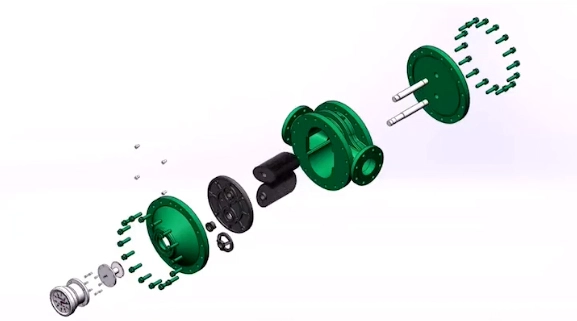
The flow transmitter is the part that directly contacts the fluid and is responsible for converting the volume of liquid flowing through into mechanical rotation.
1.1 **Measuring Chamber**: This is the core space for volume measurement, usually formed by the **body (meter casing)** and **upper and lower cover plates**.
1.2 **A Pair of Elliptical Gear Rotors**: These are the most critical measuring elements of the flowmeter. Two intermeshing elliptical gears are installed in the measuring chamber and rotate under the pressure difference between the fluid inlet and outlet. Together with the inner wall of the measuring chamber, they form **crescent-shaped cavities** of known volume. For each revolution, a fixed volume (usually four times the cavity volume) of liquid is transported from the inlet to the outlet.
1.3 **Sealing Coupling**: It transmits the rotation of the gears in the measuring chamber to the external counting mechanism and also provides sealing to prevent liquid leakage. Common types include **magnetic couplings** and **axial couplings**.
**II. Counting Mechanism (Display and Transmission)**
The counting mechanism is the “brain” of the flowmeter. It receives the rotation signal from the transmitter and converts it into readable flow data.
2.1 **Reduction Gear Mechanism**: Since the rotational speed of the elliptical gears is usually relatively high, the reduction mechanism is used to reduce the speed to a frequency suitable for counting and display.
2.2 **Adjustment Mechanism**: Used for fine adjustment or calibration of the flowmeter’s measurement accuracy.
2.3 **Counter**: Used to directly display the cumulative total and/or instantaneous flow rate of the fluid. Common display methods include **pointer type** and **roller cumulative type**; modern models often use **liquid crystal displays (LCD)**.
2.4 **Signal Transmitter**: Used to convert mechanical rotation into electrical pulse signals for remote transmission of flow rate. These signals can be output to secondary instruments (such as PLC and DCS systems) for centralized control and recording. Output signal forms include **pulse output** and **4–20 mA analog signals**.
**III. Other Key Components and Materials**
In addition to the core parts above, the flowmeter also contains many important auxiliary components. The selection of their materials directly affects the applicable scenarios and service life of the flowmeter.
3.1 **Body**: Material options include **cast iron, cast steel, and stainless steel**, which should be selected according to the corrosiveness of the measured liquid.
3.2 **Gears**: **Cast iron, stainless steel, aluminum alloy**, etc. These are core measuring elements, and their materials must be compatible with the fluid.
3.3 **Shaft**: **316 stainless steel**, etc., used to support the rotation of the elliptical gears.
**IV. Special Structural Variants**
To adapt to specific operating conditions, oval gear flowmeters also have special structural designs:
4.1 **High-Temperature Type**: A **heat sink/radiator** is installed between the transmitter and the counting mechanism to prevent high-temperature fluid from damaging the counting components.
4.2 **High-Viscosity Type**: Designed for high-viscosity media, possibly using special tooth profiles of elliptical gears (such as **elliptical gears with undercut/fewer teeth**) to reduce resistance.
In summary, the oval gear flowmeter performs volume measurement through the gear pair in the measuring chamber, transmits the motion through the sealing coupling, and finally completes display and signal remote transmission through the counting mechanism. The flexible selection of materials for its various components enables it to be widely used for the measurement of various liquids in fields such as petroleum, chemical, and pharmaceutical industries.