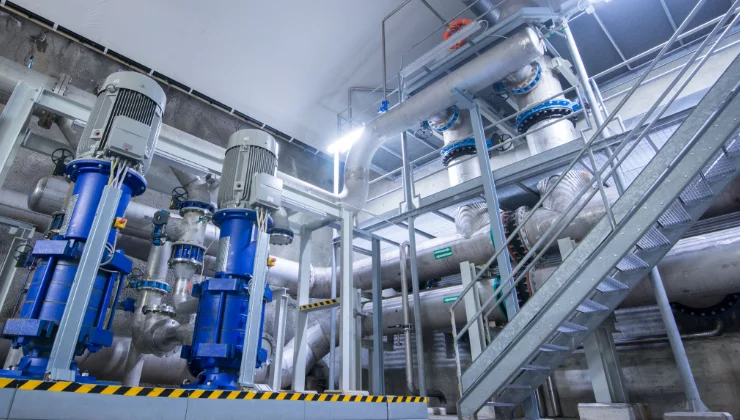







Sewage treatment is the primary application field for electromagnetic flowmeters. In various stages including influent, aeration tanks, sedimentation tanks, reaction tanks, sludge return, and effluent discharge, electromagnetic flowmeters must be installed to accurately monitor wastewater flow distribution, optimize treatment processes, and enhance treatment efficiency.
Water Source Withdrawal Metering: Precisely measuring water withdrawal volumes to ensure compliant utilization of water resources.
Case Example: A 100,000 m³/day Sewage Treatment Plant
The influent contains large amounts of suspended solids, fibrous impurities, and corrosive gases such as hydrogen sulfide. The medium is complex, and flow rates fluctuate significantly. After adopting electromagnetic flowmeters, the operational failure rate was reduced by over 90%, and accurate measurement performance was maintained even under low-temperature winter conditions.
Municipal Drainage Network Monitoring
Urban stormwater and sewage pipelines often operate in partially filled conditions, where conventional full-pipe flowmeters tend to fail. Partially filled pipe electromagnetic flowmeters are specifically designed for such scenarios, enabling accurate measurement of sewage flow in half-full or intermittent flow conditions. This assists municipal authorities in monitoring sewage discharge volumes and assessing pipeline network performance.These devices are also applicable for rainwater-sewage diversion monitoring and extraneous water intrusion identification, providing quantitative data for investigating illegal connections, detecting pipeline defects, and analyzing siltation. They serve as crucial data support tools for smart water management initiatives.
Landfill Leachate Treatment
Leachate is the contaminated liquid generated in landfills, incineration plants, and waste transfer stations. It is characterized by complex composition, high COD/ammonia nitrogen concentrations, strong corrosiveness, and a tendency to cause clogging.Specialized electromagnetic flowmeters offer significant advantages in this field:
Industrial Wastewater Discharge Monitoring
In industries such as chemical manufacturing, pharmaceuticals, papermaking, and electroplating, electromagnetic flowmeters are used for real-time monitoring of industrial wastewater discharge. The wastewater composition is complex, often containing acids, alkalis, heavy metals, and suspended solids. Electromagnetic flowmeters feature obstruction-free measuring tubes with smooth inner walls, allowing impurities to pass through smoothly without causing blockages. Combined with corrosion-resistant materials such as PTFE liners and Hastelloy electrodes, they are well-suited for various highly corrosive industrial wastewaters.
Environmental Water Bodies and Groundwater Resource Monitoring
Remediation of Black and Odorous Waterways: Used to monitor changes in water volume before and after river remediation, providing data for evaluating treatment effectiveness.
Groundwater Monitoring: Installing electromagnetic flowmeters in monitoring wells to obtain water level and flow data, enabling timely assessment of groundwater extraction and utilization.