





Measurement principle and main components of an electromagnetic flowmeter
Release time: 2026-06-29
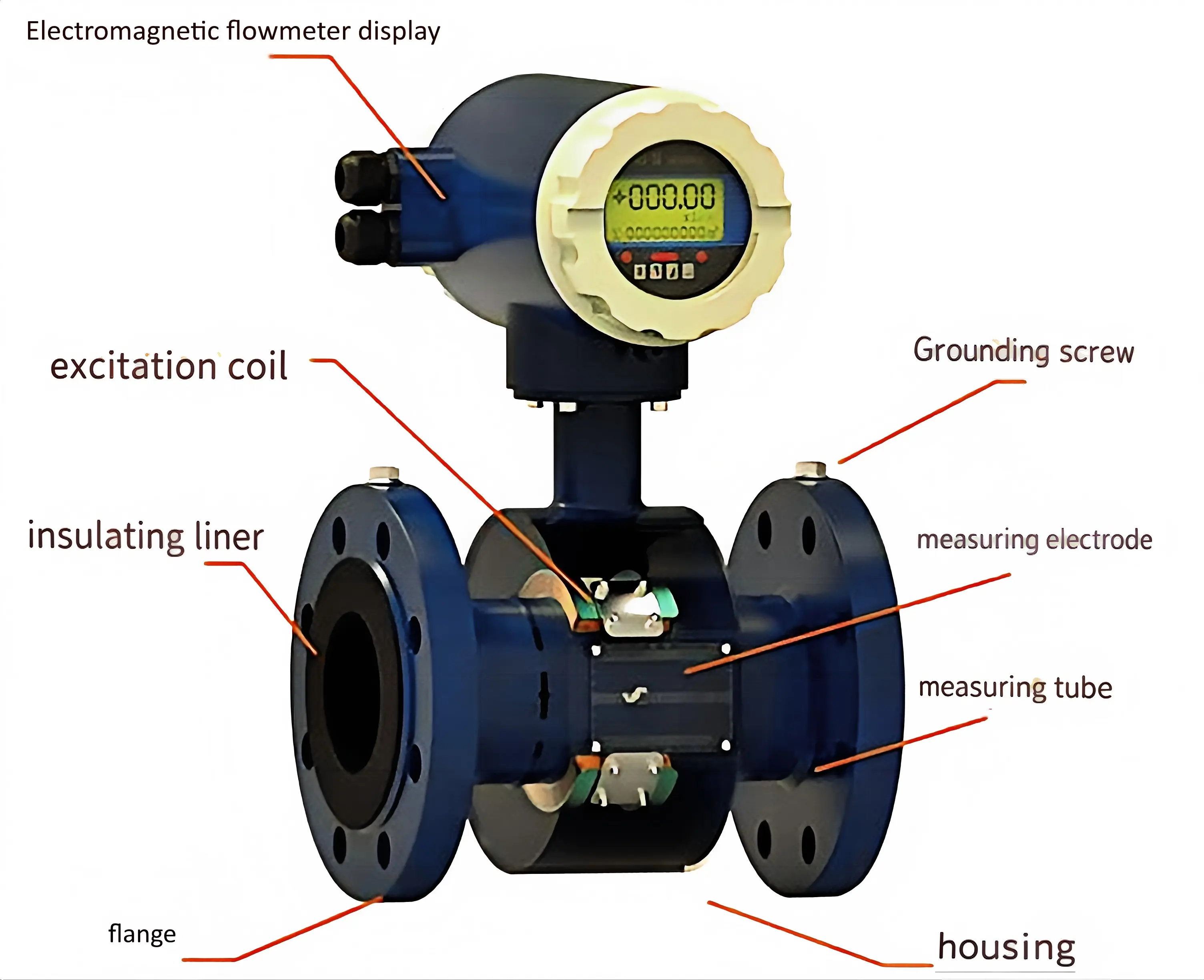
An electromagnetic flowmeter is an instrument designed based on Faraday’s law of electromagnetic induction, specifically used for measuring the volumetric flow rate of conductive liquids. Its core measurement principle originates from Faraday’s law: when a conductor moves through a magnetic field and cuts magnetic field lines, an induced electromotive force is generated. The specific working process is as follows: first, after the excitation coils inside the flowmeter are energized, they generate a magnetic field that passes through the measurement pipe; when the conductive liquid flows through the measurement pipe, it acts as a conductor cutting the magnetic field lines. At this point, on both sides of the pipe, perpendicular to both the direction of liquid flow and the magnetic field direction, an induced electromotive force proportional to the flow velocity is generated. The electrodes installed on the inner walls of the pipe detect this weak induced electromotive force, and then the converter amplifies it and converts it into a standard signal, finally calculating the volumetric flow rate through a formula. When the magnetic field strength (B) and the pipe diameter (D) are fixed, the flow rate is linearly related to the induced electromotive force.
An electromagnetic flowmeter mainly consists of two major parts: the sensor and the converter. The sensor is installed on the pipe and is the part in direct contact with the fluid. It includes the following components: the measuring tube (the pipe through which the fluid passes, usually made of non-magnetic, low-conductivity materials such as stainless steel or plastic), the excitation coils (one above and one below the measuring tube, which generate the working magnetic field when energized), the electrodes (installed on the inner wall of the measuring tube, in contact with the fluid, used to detect and lead out the induced electromotive force signal), the lining (an insulating layer on the inner side of the measuring tube, which isolates the metal tube wall to prevent short-circuiting of the induced potential and also provides corrosion resistance), and the housing (which protects the internal components, typically made of ferromagnetic material to shield against external magnetic interference).